If you have 20/20 vision, you have average or normal vision - not perfect vision mind you, just average vision. The 20/20 designation simply means that you can see at 20 feet what the average person can see at 20 feet. Many people have vision better than 20/20.
To determine what your numbers are, most eye doctors use the Snellen Chart. It has lines of letters on it that start out large at the top and end up small at the bottom. The 20/20 line is near the bottom of the chart. In a doctor's office, it is usually placed 20 feet away from you. If you can read the 20/20 line, you have 20/20 vision.
It can be challenging to translate the Snellen Chart for use online, simply because of the different sized monitors and screen resolutions available. For this test to be as accurate as possible, you need to do the following:
To determine what your numbers are, most eye doctors use the Snellen Chart. It has lines of letters on it that start out large at the top and end up small at the bottom. The 20/20 line is near the bottom of the chart. In a doctor's office, it is usually placed 20 feet away from you. If you can read the 20/20 line, you have 20/20 vision.
It can be challenging to translate the Snellen Chart for use online, simply because of the different sized monitors and screen resolutions available. For this test to be as accurate as possible, you need to do the following:
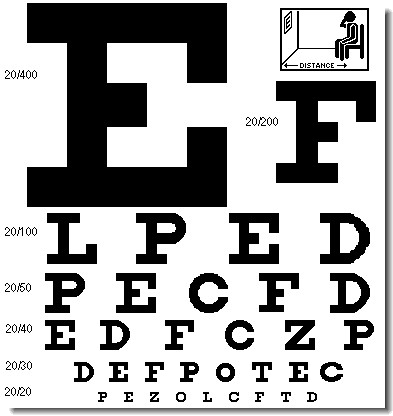
Use a standard ruler to measure the length of the big "E" at the top of the chart. Then multiply that number by 2.838. For example, if the big "E" is 2 inches in length, you will need to sit 5' 8" from the screen. Once you are at the proper distance, start reading the letters starting at the top. When you reach a line of letters that you cannot read, the line above it will be your approximate vision strength. Keep in mind that this is not an official medical diagnosis, you must see a qualified eye doctor for that. When you're done, scroll down for more information about the results of your Snellen Eye Test.
How To Take The Internet-Based Snellen Eye Test:

About The Results Of Your Snellen Eye Test:

Let's suppose you can't read the letters on the 20/20 line, but you can make out the letters on the 20/40 line above it. That means that you can see at 20 feet what those with normal vision can see at 40 feet. You have 20/40 vision. If all you could see was the large E at the top of the Snellen Chart, then your vision would be 20/400. You'd be seeing at 20 feet what a person with normal vision can see at 400.
Thanks to today's corrective lens technology and surgical techniques, having less than 20/20 vision is rarely a major problem. The problems begin when the vision cannot be corrected to 20/20 with glasses, contact lenses, or corrective surgery. There are people, for example, who can barely read that 20/400 Snellen E with their naked eyes, but once they put on their glasses or contacts they can pass the eye test for a driver's license. They may be blind without glasses, but not with them. The legal definition of blindness, by the way, is vision that cannot be corrected to better than 20/200.
Thanks to today's corrective lens technology and surgical techniques, having less than 20/20 vision is rarely a major problem. The problems begin when the vision cannot be corrected to 20/20 with glasses, contact lenses, or corrective surgery. There are people, for example, who can barely read that 20/400 Snellen E with their naked eyes, but once they put on their glasses or contacts they can pass the eye test for a driver's license. They may be blind without glasses, but not with them. The legal definition of blindness, by the way, is vision that cannot be corrected to better than 20/200.

Take The Snellen Eye Test Online:
Contact Lenses | Glaucoma | Just For Fun | Eyeglasses | Eye Doctor | Eye Care And Symptoms | Eye Anatomy | Online Eye Tests | Laser Eye Surgery | Laser Eye Surgery Directory: Canada | Laser Eye Surgery Directory: USA | Laser Eye Surgery Reviews | Submit A Review | Contact Us | Privacy Policy | Sitemap
Copyright 2006-2009 Vision Health